Friday, 14 September 2012

Lardo, London

Lardo
Courgette, goats' curd & anchovy pizza

Any place where nobody raises an eyebrow at someone knocking back a gin cocktail with a slice of  Melanzane alla Parmigiana is my type of place.  Lardo is the kind of restaurant where you can just relax and enjoy simple, good food. The cooking is consistent and confident, service is knowledgable and kindly, everyone knows what they're doing and they give every impression that they're happy to be there.  In short, it's very hard to find a bad word for Lardo.

Opened by Eliza Flanagan, formerly general manager of Bistrotheque, and Young British Foodie, Matt Bedell, in July this year, the menu is short and not too stretching.  Head Chef Damian Currie, formerly at Zucca and St John Bread & Wine should ensure a keen following.

Carnivores could be disappointed unless they make the most of the charcuterie, though I hear there is suckling pig to be had some days.  With carefully sourced pork from Graham Waddington of Native Breeds, and a preference for the rare, curly-haired, Mangalitza pig, the team spent a year working to perfect their own charcuterie.  The resultant coppa, cured loin, salami and lardo are served up as small plates and sometimes used on pizzas. Charcuterie and Pizza pretty much sums up Lardo.  A madly glitzy disco ball oven squats in the corner of the open kitchen, its gaping jaws hungry for wood throughout service.  Thin, crispy disks of dough are draped with thoughtful seasonal toppings.

Lardo
Melanzane alla Parmigiana
There are a few non-meat small plates too - with an emphasis on the small.  On two separate visits we ate a good slice of Melanzane alla Parmigiana served at just the right temperature to appreciate the flavours; a beautifully fresh plate of Broad beans, pea shoots, pecorino and mint served with pretty good focaccia; and three of the pizzas - Courgette, goats' cheese, and anchovy; a Lardo with rocket; and a classic Margherita.  All the pizzas were good but it was the most beautiful to look at, courgette (pictured above), which became a little dry and boring towards the end.  Nothing a slug of good olive oil wouldn't have fixed.  As yet I've failed to get as far as the puddings.

Housed in the ground floor of the warehouse-like Arthaus building, it's a 5 minute walk from London Fields railway station.  Come December, that lovely disco ball of fire in the corner is going to make Lardo the cosiest winter spot in Hackney.

You can expect to pay around £4-7 for small plates and £8 or £9 for pizzas, so it makes for a very reasonable meal.  There's a decent range of European wines on the drinks list plus freshly squeezed juices, but so far I'm afraid I've failed to progress beyond those Limonade and Bitter Lemon Sipsmith gin cocktails.

Lardo
197-205 Richmond Road
Hackney
London  E8 3NJ
Tel: 020 8985 2683
@lardolondon
Open 7 days a week

Thursday, 13 September 2012

Le Coq Rico, Paris - Classy Chicken & Chips

Le Coq Rico
Paris

Given the fact you can eat your way around the globe in London, it's surprising how difficult it is to find a good plate of chicken and chips.  Not that we don't have an abundance of unfortunate 'Chicken Shops', but these I will gloss over.  What I'm looking for is top quality chicken, expertly roasted, served with its precious juice and a little garlic with a cone of perfectly cooked chips alongside.  Maybe with a simple, fresh properly dressed green salad.  I'm looking for a place that honours the bird and knows how to use every morsel to best effect.

Le Cafe Anglais  in Bayswater and Les Deux Salons in Covent Garden both do a pretty good job of roasting a chicken, and then there is Mark Hix's Tramshed in Shoreditch.  I can't comment on the Tramshed.  When Hix removes the Damien Hirst cow with a chicken on its back I'll give it a go.  There are one or two new openings in London but they look to the American way rather than the French - and if you want marinades, BBQ, onion rings and Philly cheese that's fine.  I don't.  What I'm looking for is focus, somewhere that makes poultry the star, not something to carry a myriad of flavours.

In Paris they know how to do this, though it's not as easy to find a good one as you might think.  Good butchers sometimes have a small rotisserie outside.  Anyone who's been to Paris has experienced that  aroma of roasting chicken drawing you down the street.  You can take home a roasted Poulet Fermier and, if you are lucky, some potatoes which have been cooked under the spit in the Lèchefrite.  There are plenty of restaurants serving Poulet Frites but, until now, a really good one celebrating the chicken has eluded me.

Montmartre is not where I would normally head in Paris.  I prefer to catch glimpsed views of Le Sacré Coeur by glancing up the steep streets of the 9th Arrondissement, but on a late summer's day it proved the ideal place to be.  A beautiful day, quiet streets and a perfect lunch spot on rue Lepic.  Le Coq Rico came recommended by a Parisian who knows, and he was right.

The restaurant is small and intimate without that tight-squeeze feeling you so often find in Paris.  The bar - always my first choice - provides a sleek, black granite topped view of the kitchen action.   A full- on view of the rotisserie is a wonderful thing.  Add to that a chance to observe Chef Thierry Lébé and his young team running a thoroughly professional kitchen and it's perfection.  There's focus, attention to detail and pride here.

Starters and mains revolve around chicken, guinea fowl, duck, goose and pigeon, all with detailed provenance, sourced from the regions of France that raise the very best of each kind of fowl.   Hearts are seared, gizzards confited, wings lacquered and terrines and rillettes produced for starters.  You can even have a luscious take on the boiled egg.  The rotisserie takes care of most of the mains but there's a dish of Poule au Pot too.

This being our first visit we played it safe with the quarter Challans chicken and frights with an impeccable vinaigrette-dressed salad.  The chicken was tender, moist, crispy-skinned and full of flavour - everything a rotisserie chicken should be.  Served with chicken gravy and roast garlic, it was perfect, as was the large cone of twice, or thrice, fried chips.  The one dessert we tried was good but when I order Clafoutis Peche I expect more of a batter pudding than a sponge - far be it for me to tell the French how to cook Clafoutis, it was delicious anyway.  The Verbena ice cream which came with it was fantastic.  A glass of Brouilly each and mineral water brought the bill to 72 Euros for two, though you can eat much more expensively.

Le Coq Rico only opened in January this year and is from the same stable as the highly regarded Drouant and Mon Vieil Ami.  All three are overseen by Alsatian chef Antoine Westerman.

Back in London, I hear Nick Jones of Soho House is set to open "Chicken Shop' in Kentish Town.  Maybe that will push my buttons but if, once again, I'm disappointed I'll just have to keep taking the Eurostar to Le Coq Rico where they know how to do this sort of thing.

Le Coq Rico
98 rue Lepic
75018 Paris
Tel: +33 (0)1 42 59 82 89
Open 7 days a week

Thursday, 6 September 2012

Classic Pasta Carbonara

Classic Pasta Carbonara

I've eaten many versions of the classic pasta dish 'Carbonara'.  Given how few ingredients it takes to make the sauce it's amazing how different they have each been.  Although carbonara is regarded as a classic, there's no recorded recipe before the 1940's.  Certainly there's no mention of it in Pellegrino Artusi's opus La scienza in cucina e l'arte di mangiare bene published in 1891, nor in Ada Boni's La Cucina Romana published in 1927, so it's a relative newcomer in pasta sauces.  The name is generally attributed to the charcoal workers in the Lazio region of Italy - Carbonari - so it's mostly found in and around Rome.

This recipe is based on Jacob Kenedy's which is in his book The Geometry of Pasta.  The recipe caught my attention because it calls for guanciale, cured pig's cheek, rather than pancetta.  Having recently found a source of this hard to find cured pork, I wanted to make the most of it.  Guanciale has a lovely piggy flavour and a particular fattiness which emulsifies beautifully with the other ingredients the recipe calls for.  Carbonara is a rich sauce so you may as well go the whole hog, so to speak.  This is not a dish for the calorie conscious, or as Kenedy puts it, it's " ... almost a heart attack on a plate" but it is "surely a good way to go ..."

Obviously the shape of dried pasta chosen makes a difference too.  Opinion is divided as to which is best.  Personally, I like to use spaghetti or linguine. Jacob Kenedy prefers bucatini.  I've adjusted the quantities to suit the appetite of my family and, because I don't like pasta with too much sauce, but essentially this is Kenedy's recipe and method.  For me, it's the best - so far.

Pasta Carbonara
(Serves 4 as a starter or 2 as a main)

175g spaghetti/linguine (or other dried pasta)
100g guanciale (or pancetta) in a 3mm thick slice, then cut into lardons 
1 dessertspoon olive oil
2 small eggs
60g grated Pecorino Romano or parmesan, plus extra to serve
Lots of freshly crushed black pepper 

While you cook the dried pasta, fry the guanciale in the olive oil over a high heat until the fat blisters and browns but is still soft (being fatty, it will smoke).  Take the pan off the heat.
In a large bowl, beat the eggs with the cheese and add the pepper.  Warm the bowl just a little over the boiling pasta water.  
Once cooked, drain the pasta and add to the guanciale, tossing to coat it in the fat.  Pour into the the bowl and stir well for a minute to partially thicken the egg.  Check the seasoning and serve with extra cheese on top.


My source of guanciale is The Ham & Cheese Co

Thursday, 30 August 2012

The Little Bread Pedlar - perfect croissants


LBP Almond Croissants
at Monmouth Coffee

A 4am alarm call is not my idea of a great way to start the day but the promise of croissants fresh from the oven overcomes my slothful tendencies.  Not that I’d get out of bed at this time for just any croissant.  I know them to be the finest croissants in London and I’m not about to pass up the chance of tasting one just 30 minutes old.

By 5am I’m crossing London Bridge.  The sun is shining and the sky is blue, lifting the spirits of the nightshift workers, cleaners and deliverers, who are surprisingly numerous at this hour in the capital.  The irresistible aroma of baking is in the air as I peel back the shutters of The Little Bread Pedlar artisan bakery in Bermondsey. 

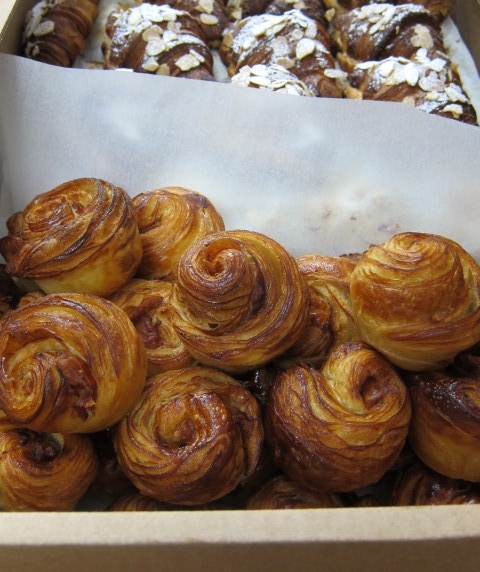
'Parma Rose' pastries
A conversation with Anita le Roy of Monmouth Coffee on the difficulties of finding good pastries in London had alerted me to an embryo business focusing on baking brownies and croissants.   Well, if Anita was impressed, I had to find out more. 

After 10 years working as a pastry chef, Nichola began baking a small range of cakes and breads and trading as Cherry Pippin on Pimlico’s Tatchbrook Street market.  Success with this venture and encouragement from Leila McAllister of Leila’s Shop in Shoreditch/ Spitalfields and Anita le Roy gave Nichola and partner Martin the confidence to launch The Little Bread Pedlar (LBP).  The initial aim was to perfect the best artisan chocolate brownies and croissants in London and supply businesses they admired.  By the end of November 2011 perfect croissants were being biked across London.  Not that it was easy.  Managing with domestic equipment meant long hours.  Christmas saw them move into bigger premises and take delivery of better equipment, including a longed-for proving cabinet.  They no longer have to get up in the middle of the night to attend to the pastries. 

Mixing the brioche dough
The move brought problems too, with getting used to the new equipment causing the most headaches.  The hours are still long but they now have a good team including bakers Stewart and Hannah, and Ruth who, amongst other things, pedals one of those covetable delivery bikes I mentioned.  It’s a tight-knit team and all are very much part of the “family.” 

The three restored Pashley deli bikes are not just there to provide a pun on pedaller/pedlar, but are an important sustainability component of the business. Up to now, new customers have been gained by word-of-mouth and are only accepted if within range of the bikes.  The long counter in the bakery was constructed from old pallets and second-hand boards rescued from Monmouth Coffee’s recent refurbishments.  Waste is kept to a minimum thanks to Nichola’s inventiveness, exemplified by her development of LBP’s ‘Parma Rose’ (a signature pastry).  A delicious curled bud of croissant dough enfolding excellent Parma ham supplied by their near neighbours The Ham & Cheese Company.    

Rolling the croissant
For now, consistency of the current range is top of their agenda.  Provenance of ingredients is of utmost importance.  Organic flour comes from Shipton Mill, eggs are organic and free range, Lescure butter and Valrhona chocolate is used.
By the time I arrive bleary-eyed on this sunny morning, Nichola and Martin have already been hard at work for around 2 hours.  Nichola and assistant baker Hannah are absorbed in checking the proved croissants, pains aux chocolat and aux raisin ready for baking.  Nichola will also hand-shape the brioche.  A glass of Martin’s pour-over of Colombian Tunja Grande coffee and a just-baked buttery shortbread erase the memory of that shockingly early alarm call.  A few golden brown, flaky croissants are already out of the oven, but there’s much more to come.

Croissants cooling
Soon the pace quickens and tray after tray of plain and almond croissants, pains au chocolat and aux raisin make their way in and out of the ovens along with the Parma Roses.  Previously-cooked and cooled chocolate brownies are cut to add to the orders.  By 7.00am the delivery bikes are loaded up with one destined for customers in West London and another headed East.   

As the bakery falls quiet there’s time to talk before afternoon preparation for the following day’s bake begins so I take my opportunity to ask Nichola a few questions:


Q  Where did you work before starting your own business?

A  I've been a chef for 11 years and worked in a couple of places in Glasgow before moving down to London. I was at The Anchor and Hope in Waterloo for three years and then at St. John Bread and Wine for a year.


Q  Who or what has been the biggest influence on your career?

A  I have to say my Mum! For two reasons: Firstly, she has always encouraged me to follow my dreams and never pressured me to do the wrong thing for the right reasons. Secondly, she hates cooking and as a consequence I learnt to cook as soon as I could because I love eating!

          
Q  What made you take the leap to set up your own business?

A  Martin, and the fact that I didn't want to get to 40 and still be sweating it out in a kitchen running around doing service.


Q  What's the best piece of advice you'd offer a budding baker?
A  Be prepared for long shifts and anti-social hours.  On a lighter note, always carry a little plastic scraper, they are useful for almost every job!


Q  What does "community" mean to you?
A  Conversation, helping each other and sharing ideas.


Q  What is the key to a successful croissant?
A  Maintaining good distinct laminations - dough and butter temperatures being key factors.


Q  Can you explain the effect of a slow fermentation on the finished croissant?

A  Slow fermentation ensures a more complex flavour profile for the finished croissant and improves its keeping quality, sometimes staying crispy until the next day.

A source of inspiration for LBP is the award winning Tartine Bakery in San Francisco.  Tartine espouse the, to some, radical philosophy of “Fresh bread for dinner …. toast for breakfast” to encourage customers to buy their bread on their way home from work.  Even more extremist, they don’t do cupcakes, and you won’t find them at LBP either!  

Nichola laminating
After my early morning experience I’m keen to see the full preparation and baking cycle so I return a few days later to see afternoon operations.  The croissant dough having been formed, there’s the ’laminating’ (folding), rolling, cutting and shaping.  ‘Parma Rose’ buds are wrapped and the butter-rich brioche dough is mixed.  The proving cabinet is pressed into service to allow a slow, controlled overnight  fermentation.  A batch of morning-shift croissants are split, filled with almond paste, and topped with flaked almonds to await a further bake.   Then it’s time for a late staff communal lunch, some paperwork, calls to return and maybe, just maybe, a few hours to relax.

Almond croissant
fresh from the oven
So far the one thing LBP have not had to work hard at is attracting customers.  The business is growing at a manageable pace.  Quality and reliability is of paramount importance to them.  "There’s no let-up” but they are determined to “never let anyone down”.  Recently they’ve added a few notable cafes to their customer list - AssociationEC3 , Rough Trade off Brick Lane, Café Oto, and Reilly Rocket.  

Croissant boxed for delivery
LBP isn’t planning to let the grass grow under its feet.  The bakery already opens on Saturdays only for retail trade.  A small selection of breads are added to the bake, including an amazing ‘Butter Bread’ invention, Bakewell tarts and individual bread puddings with a twist, so the Friday night shift is somewhat busier. 

Very soon Nichola and Martin will be opening a little neighbourhood café in nearby Abbey Street, which will allow Martin to indulge a passion for coffee.  Nothing fancy, just a modest little spot where locals and those passing through Bermondsey can be sure of a good cup of coffee and a great croissant, or a fantastic brownie. 

I did, by the way, get my 30 minute old croissant that morning, and it was as sensational as I had hoped.

The Little Bread Pedlar 
Unit 5, Dockley Road, London SE16
Spa Terminus

A version of this article can be found on The Foodie Bugle

*** STOP PRESS - Look out for fantastic Eccles Cakes now too ***

Other Postings which might interest you:
Monmouth Coffee
Leila's Shop
The Ham & Cheese Company

Monday, 27 August 2012

Plum Tart

Slice of Greengage Tart

Our short plum season is in full swing so it's time to make the most of it.  The tiny elusive golden Mirabelle, which heralds the start of the harvest has already been and gone here.  They were very hard to find this year and I only managed to get enough to make a couple of clafoutis.  The fruits are usually too small to remove the stone, and anyway cooking them stone-in brings out the natural almond notes.  You do have to remember to warn everyone about the stones though!

After the Mirabelle comes the Gage, or Reine Claude, group.  Sir William Gage brought reine-claude trees over from France in the early 18th century but, the labels having been lost, the fruits became known as 'the green Gage's plum', later 'greengage'.   Nurseryman Jervais Cole subsequently hybridised the reine-claude producing new varieties Coe's Golden Drop, Coe's Violet and Coe's Crimson Drop.  Though considered superior in flavour they proved to be poor croppers so were not favoured by commercial growers.  These days we can generally only buy 'greengages' but, oh, how I'd like to try a Coe's Golden Drop.  As Jane Grigson learned when researching her Fruit Book, 'the skin is rather tough, but between this and the stone floats an ineffable nectar'.  The pale green to gold hue of the greengage belies the juicy sweetness within.  They're good to eat just as they are but I like to use them in cooking as they need very little sugar to bring out their flavour.


Greengage Tart
The plum/ gage and fruits such as peaches, apricots and cherries, share the same genus (Prunus) as the sweet almond so you often see almonds paired with stone fruits. Bitter almond extract or Amaretto can be added to further heighten the flavour.  The bitter almond is extracted from the kernel inside the stone, particularly of apricots, but, should you be tempted to make your own, take care as the fruit kernels contain a cyanide compound which needs to be removed by a roasting process.

I used greengages for this tart but any plum will work, just vary the amount of sugar you sprinkle on them depending on their natural sweetness.  I like to use vanilla sugar and keep a jar of caster sugar in which I store used vanilla pods to permeate the sugar.   Vanilla is an expensive spice but it's worth buying the best you can afford.  It should be glossy, wrinkled but pliable and, I think, have a prune-like aroma.  Making use of the pods after they've been used in, say, a poaching liquid renders them a more economical buy.  I leave the skins on some of the almonds for a more rustic texture and better flavour.

Plum Tart
(23cm  tart tin)

PASTRY (makes 2 x 23cm tart cases – you’ll need one for this recipe):

250g (10oz) plain flour
25g (1oz) ground almonds
Pinch of salt
150g(6oz) cold unsalted butter
75g (3oz) icing sugar
Grated rind of half a lemon
1 egg yolk
3 tablespoons milk


FILLING:
125g unsalted butter, softened
125g whole almonds - blanch half of them and remove the skins then coarsely grind all
75g caster sugar
½ tblsp plain flour
1 egg
8-10 plums, halved and stoned
25g vanilla caster sugar (more if fruit is tart)

Sift the flour into a mixing bowl and add the ground almonds and salt. Add the butter and rub in with fingertips. Sift in icing sugar and add grated lemon rind and mix. Lightly beat the egg yolk and milk together and stir it into the dry ingredients. Mix just until the dough comes together then turn out and knead gently to smooth the surface.  Wrap half of the pastry and rest in fridge for just 30 minutes (wrap and freeze the other half for another time).

Pre-heat the oven to 200C (180C fan oven) Lightly butter a 23cm loose-bottomed tart tin.   Roll out the pastry thinly and line the tin, smoothing off the top and pricking the base. Rest in the fridge for a further 15-30 minutes.  

Line with greaseproof paper and dried beans and bake the tart blind for 10 minutes.  Remove the lining and beans and return the tart to the oven for a further 4-5 minutes to make sure the base is cooked.  Remove from the oven and turn the oven temperature down to 160C (140C fan).

For the filling, whisk the softened butter and sugar together until pale.  Mix in the ground nuts and flour, then the egg.  Spoon into the pastry case and spread evenly.  Push the fruit in, cut side up and sprinkle a little of the vanilla sugar over each plum half.  Cook for 35-40 minutes.  Cover with foil if the tart is browning too much.

Best served warm with double cream but this tart keeps well for a day or two.

Monday, 20 August 2012

Railroad Cafe, Hackney


Railroad Hackney
Roseval Potato & Fresh Coconut Curry

"Railroad in Hackney" kept cropping up in conversation so often that I had to take a look.  On a sleepy August afternoon - post-Olympics and mid-school holidays - I finally took the 5 minute stroll from the Hackney Empire to this welcoming corner cafe/restaurant on Morning Lane.  With a view of the Hackney Central to Homerton railway line, it wasn't difficult to focus on the cooking.  What the location lacks in beauty, Railroad made up for in food and friendliness.  It's the kind of place you'd feel lucky to have in your neighbourhood.

The lunchtime cafe menu is short but thoughtful and priced temptingly.  A Vietnames sandwich with spiced pork and pickled vegetables, a meat and salad dish and an interesting spiced vegetable dish, such as a Moroccan Zaalouk, are the what you can expect.  Spices are clearly a passion and it was no surprise to learn that Railroad is run by Lizzie Parle, sister of Stevie of Dock Kitchen, and her partner Matt Doran.  An Onglet steak was briefly seared and served with a hot chilli sauce and a cooling beetroot puree plus griddled sourdough drizzled with olive oil  A dish of Roseval potatoes and fresh coconut curry was pretty as a picture and completely delicious.  The spicing, including chilli, cardamom and coriander, was subtle yet punchy and I'm sure more complex than my palate could decipher.  Good, freshly made chapatis were perfect for mopping up the sauce.  A couple of generous glasses of Tempranillo brought our quick lunch for two in at around £27, so call it £30 with service.

You can have breakfast at Railroad too, and Wednesday-Saturday it becomes more of a restaurant in the evening with a still short but interesting menu.  There's a commitment to seasonality - good for eating ingredients at their best and for keeping prices down - and to buying local.   Spices come from a Turkish corner shop, meat from a local butcher and excellent bread from E5 Bakehouse, a 15 minute walk way.  I also noticed they keep a pale ale from Bermondsey's Kernel Brewery and coffee from Square Mile.  The kitchen is open, in a homely rather than a 'look-at-me' way, and the fittings second-hand.  A small bookshop area displays books to browse and buy, some by local authors and there's a changing gallery of works by favourite photographers on the walls - currently the work of Lillian Wilkie.  As at least half of London seems to have decamped at the moment, atmosphere is a tricky one to comment on.  London in August is fast becoming as sleepy as Paris but Railroad was a happy find.  They're now closed for their own week-long summer break and will re-open on 25 August.

Railroad is not as isolated as it might seem if you don't know this area, which is fast becoming the food destination of London's East End.  Bakeries, coffee roasters, cafe and restaurant pop-ups are all contributing to the revitalisation of the Dalston, London Fields, Homerton and Hackney Wick areas.

If, as I did, you gaze towards that unexciting railway line and wonder what's on the other side, you'll find it well worth exploring.  Sutton House, under the care of The National Trust, is a Tudor gem.  It's one of only a handful of National Trust properties in London and well worth a visit.

120-122 Morning Lane
London E9 6LH


Tuesday, 14 August 2012

Coffee at Spa Terminus - Food Find

Monmouth pop-up
at Spa
For those of you who have been disappointed to find you can no longer get your Saturday morning coffee at Monmouth on Maltby Street, here's some good news.  Walk 5-10 minutes up the railway line eastwards and you'll find a Saturday Monmouth pop-up at Unit 3 Spa Arches Northside (between Dockley Road and Spa Road SE16).  Open from 8-12 for take-away drinks and currently until 1.30pm for whole or ground beans.  Sadly, you can't buy food there but their croissant/ brownie supplier, The Little Bread Pedlar, is open on the other side of the arch at Unit 5 Dockley Road.  Coleman Coffee are also trading at Spa and you can find them in The Little Bread Pedlar unit 08.30-3pm.

Here's a map http://www.maltbystreet.com/

Saturday, 11 August 2012

Season of plums, gages and cobnuts - Food Find

London Market Shop
11 Aug 2012
We're approaching that time when the soft peaches, berries and currants make way for plums and gages.  At market today Greengages, Mirabelles and Early Laxton plums drew attention away from the last of the high summer fruits.  The Mirabelles are not at their most honeyed yet but wait too long and you'll miss them.  This week's buy are destined for a Clafoutis, I think.  Word has reached me of a solitary Mirabelle tree in a local park so I will definitely be checking that out in the coming week.

The first milky-fleshed Kentish Cobnuts were at market today too.  We need to eat these fresh to appreciate them at their best.  Later harvestings, into October, will have a fuller but less juicy ripeness.  We've been buying French sweetcorn for a couple of weeks now but today saw the arrival of the first Isle of Wight grown corn cobs - small but perfectly formed.


Little Bread Pedlar Eccles Cakes - Food Find

Little Bread Pedlar
Eccles Cake
Today at Spa Terminus The Little Bread Pedlar was selling Eccles Cakes.  I got there when they had just come out of the oven and were too hot to be sold.  I reserved two and by the time I went back to collect them ten minutes later the rest had almost all gone.  Light, buttery pastry, quality dried fruit and a not too sweet filling puts them up there with the best.  I, for one, hope they will be a regular featue.  It certainly made up for the disappointment of arriving too late for croissants today - all sold out before mid-day at the bakery.


The Little Bread Pedlar
Unit 5 Dockley Road
Spa Terminus
Bermondsey
London SE16
(The bakery is open for retail sales Saturdays 9-2pm.  Check their site for outlets)

Thursday, 9 August 2012

Pêche de Vigne - Food Find

Pêche de Vigne
At last peaches and nectarines are reaching their best.  The flat varieties I've been buying are particularly good this year.  Now they've been joined by the French Pêche de Vigne, or Blood Peach.  Planted in vineyards as a fragile counterpart to the tough grapevine, it provides an early indication of disease attacking the vines.  The familiar peachiness is sharpened by a red-fruit tang similar to that in blood oranges.  Some of these dusky-skinned peaches find their way across the channel but you've probably only got a couple of weeks to get your hands on them.  This beauty came from Leila's Shop in Shoreditch along with some gorgeous black Muscat grapes, but ask your greengrocer about the special Pêche de Vigne .