Thursday, 30 August 2012

The Little Bread Pedlar - perfect croissants


LBP Almond Croissants
at Monmouth Coffee

A 4am alarm call is not my idea of a great way to start the day but the promise of croissants fresh from the oven overcomes my slothful tendencies.  Not that I’d get out of bed at this time for just any croissant.  I know them to be the finest croissants in London and I’m not about to pass up the chance of tasting one just 30 minutes old.

By 5am I’m crossing London Bridge.  The sun is shining and the sky is blue, lifting the spirits of the nightshift workers, cleaners and deliverers, who are surprisingly numerous at this hour in the capital.  The irresistible aroma of baking is in the air as I peel back the shutters of The Little Bread Pedlar artisan bakery in Bermondsey. 

'Parma Rose' pastries
A conversation with Anita le Roy of Monmouth Coffee on the difficulties of finding good pastries in London had alerted me to an embryo business focusing on baking brownies and croissants.   Well, if Anita was impressed, I had to find out more. 

After 10 years working as a pastry chef, Nichola began baking a small range of cakes and breads and trading as Cherry Pippin on Pimlico’s Tatchbrook Street market.  Success with this venture and encouragement from Leila McAllister of Leila’s Shop in Shoreditch/ Spitalfields and Anita le Roy gave Nichola and partner Martin the confidence to launch The Little Bread Pedlar (LBP).  The initial aim was to perfect the best artisan chocolate brownies and croissants in London and supply businesses they admired.  By the end of November 2011 perfect croissants were being biked across London.  Not that it was easy.  Managing with domestic equipment meant long hours.  Christmas saw them move into bigger premises and take delivery of better equipment, including a longed-for proving cabinet.  They no longer have to get up in the middle of the night to attend to the pastries. 
Mixing the brioche dough
The move brought problems too, with getting used to the new equipment causing the most headaches.  The hours are still long but they now have a good team including bakers Stewart and Hannah, and Ruth who, amongst other things, pedals one of those covetable delivery bikes I mentioned.  It’s a tight-knit team and all are very much part of the “family.” 

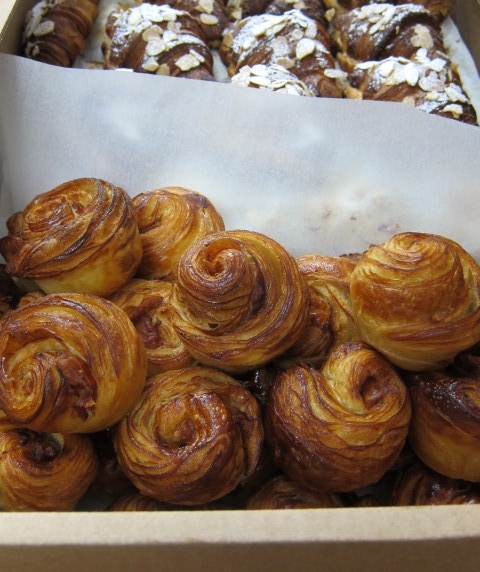
The three restored Pashley deli bikes are not just there to provide a pun on pedaller/pedlar, but are an important sustainability component of the business. Up to now, new customers have been gained by word-of-mouth and are only accepted if within range of the bikes.  The long counter in the bakery was constructed from old pallets and second-hand boards rescued from Monmouth Coffee’s recent refurbishments.  Waste is kept to a minimum thanks to Nichola’s inventiveness, exemplified by her development of LBP’s ‘Parma Rose’ (a signature pastry).  A delicious curled bud of croissant dough enfolding excellent Parma ham supplied by their near neighbours The Ham & Cheese Company.    

Rolling the croissant
For now, consistency of the current range is top of their agenda.  Provenance of ingredients is of utmost importance.  Organic flour comes from Shipton Mill, eggs are organic and free range, Lescure butter and Valrhona chocolate is used.
By the time I arrive bleary-eyed on this sunny morning, Nichola and Martin have already been hard at work for around 2 hours.  Nichola and assistant baker Hannah are absorbed in checking the proved croissants, pains aux chocolat and aux raisin ready for baking.  Nichola will also hand-shape the brioche.  A glass of Martin’s pour-over of Colombian Tunja Grande coffee and a just-baked buttery shortbread erase the memory of that shockingly early alarm call.  A few golden brown, flaky croissants are already out of the oven, but there’s much more to come.

Croissants cooling
Soon the pace quickens and tray after tray of plain and almond croissants, pains au chocolat and aux raisin make their way in and out of the ovens along with the Parma Roses.  Previously-cooked and cooled chocolate brownies are cut to add to the orders.  By 7.00am the delivery bikes are loaded up with one destined for customers in West London and another headed East.   

As the bakery falls quiet there’s time to talk before afternoon preparation for the following day’s bake begins so I take my opportunity to ask Nichola a few questions:


Q  Where did you work before starting your own business?

A  I've been a chef for 11 years and worked in a couple of places in Glasgow before moving down to London. I was at The Anchor and Hope in Waterloo for three years and then at St. John Bread and Wine for a year.


Q  Who or what has been the biggest influence on your career?

A  I have to say my Mum! For two reasons: Firstly, she has always encouraged me to follow my dreams and never pressured me to do the wrong thing for the right reasons. Secondly, she hates cooking and as a consequence I learnt to cook as soon as I could because I love eating!

          
Q  What made you take the leap to set up your own business?

A  Martin, and the fact that I didn't want to get to 40 and still be sweating it out in a kitchen running around doing service.


Q  What's the best piece of advice you'd offer a budding baker?
A  Be prepared for long shifts and anti-social hours.  On a lighter note, always carry a little plastic scraper, they are useful for almost every job!


Q  What does "community" mean to you?
A  Conversation, helping each other and sharing ideas.


Q  What is the key to a successful croissant?
A  Maintaining good distinct laminations - dough and butter temperatures being key factors.


Q  Can you explain the effect of a slow fermentation on the finished croissant?

A  Slow fermentation ensures a more complex flavour profile for the finished croissant and improves its keeping quality, sometimes staying crispy until the next day.

A source of inspiration for LBP is the award winning Tartine Bakery in San Francisco.  Tartine espouse the, to some, radical philosophy of “Fresh bread for dinner …. toast for breakfast” to encourage customers to buy their bread on their way home from work.  Even more extremist, they don’t do cupcakes, and you won’t find them at LBP either!  

Nichola laminating
After my early morning experience I’m keen to see the full preparation and baking cycle so I return a few days later to see afternoon operations.  The croissant dough having been formed, there’s the ’laminating’ (folding), rolling, cutting and shaping.  ‘Parma Rose’ buds are wrapped and the butter-rich brioche dough is mixed.  The proving cabinet is pressed into service to allow a slow, controlled overnight  fermentation.  A batch of morning-shift croissants are split, filled with almond paste, and topped with flaked almonds to await a further bake.   Then it’s time for a late staff communal lunch, some paperwork, calls to return and maybe, just maybe, a few hours to relax.

Almond croissant
fresh from the oven
So far the one thing LBP have not had to work hard at is attracting customers.  The business is growing at a manageable pace.  Quality and reliability is of paramount importance to them.  "There’s no let-up” but they are determined to “never let anyone down”.  Recently they’ve added a few notable cafes to their customer list - AssociationEC3 , Rough Trade off Brick Lane, Café Oto, and Reilly Rocket.  

Croissant boxed for delivery
LBP isn’t planning to let the grass grow under its feet.  The bakery already opens on Saturdays only for retail trade.  A small selection of breads are added to the bake, including an amazing ‘Butter Bread’ invention, Bakewell tarts and individual bread puddings with a twist, so the Friday night shift is somewhat busier. 

Very soon Nichola and Martin will be opening a little neighbourhood café in nearby Abbey Street, which will allow Martin to indulge a passion for coffee.  Nothing fancy, just a modest little spot where locals and those passing through Bermondsey can be sure of a good cup of coffee and a great croissant, or a fantastic brownie. 

I did, by the way, get my 30 minute old croissant that morning, and it was as sensational as I had hoped.

The Little Bread Pedlar 
Unit 5, Dockley Road, London SE16
Spa Terminus

A version of this article can be found on The Foodie Bugle

*** STOP PRESS - Look out for fantastic Eccles Cakes now too ***

Other Postings which might interest you:
Monmouth Coffee
Leila's Shop
The Ham & Cheese Company

Monday, 27 August 2012

Plum Tart

Slice of Greengage Tart

Our short plum season is in full swing so it's time to make the most of it.  The tiny elusive golden Mirabelle, which heralds the start of the harvest has already been and gone here.  They were very hard to find this year and I only managed to get enough to make a couple of clafoutis.  The fruits are usually too small to remove the stone, and anyway cooking them stone-in brings out the natural almond notes.  You do have to remember to warn everyone about the stones though!

After the Mirabelle comes the Gage, or Reine Claude, group.  Sir William Gage brought reine-claude trees over from France in the early 18th century but, the labels having been lost, the fruits became known as 'the green Gage's plum', later 'greengage'.   Nurseryman Jervais Cole subsequently hybridised the reine-claude producing new varieties Coe's Golden Drop, Coe's Violet and Coe's Crimson Drop.  Though considered superior in flavour they proved to be poor croppers so were not favoured by commercial growers.  These days we can generally only buy 'greengages' but, oh, how I'd like to try a Coe's Golden Drop.  As Jane Grigson learned when researching her Fruit Book, 'the skin is rather tough, but between this and the stone floats an ineffable nectar'.  The pale green to gold hue of the greengage belies the juicy sweetness within.  They're good to eat just as they are but I like to use them in cooking as they need very little sugar to bring out their flavour.


Greengage Tart
The plum/ gage and fruits such as peaches, apricots and cherries, share the same genus (Prunus) as the sweet almond so you often see almonds paired with stone fruits. Bitter almond extract or Amaretto can be added to further heighten the flavour.  The bitter almond is extracted from the kernel inside the stone, particularly of apricots, but, should you be tempted to make your own, take care as the fruit kernels contain a cyanide compound which needs to be removed by a roasting process.

I used greengages for this tart but any plum will work, just vary the amount of sugar you sprinkle on them depending on their natural sweetness.  I like to use vanilla sugar and keep a jar of caster sugar in which I store used vanilla pods to permeate the sugar.   Vanilla is an expensive spice but it's worth buying the best you can afford.  It should be glossy, wrinkled but pliable and, I think, have a prune-like aroma.  Making use of the pods after they've been used in, say, a poaching liquid renders them a more economical buy.  I leave the skins on some of the almonds for a more rustic texture and better flavour.

Plum Tart
(23cm  tart tin)

PASTRY (makes 2 x 23cm tart cases – you’ll need one for this recipe):

250g (10oz) plain flour
25g (1oz) ground almonds
Pinch of salt
150g(6oz) cold unsalted butter
75g (3oz) icing sugar
Grated rind of half a lemon
1 egg yolk
3 tablespoons milk


FILLING:
125g unsalted butter, softened
125g whole almonds - blanch half of them and remove the skins then coarsely grind all
75g caster sugar
½ tblsp plain flour
1 egg
8-10 plums, halved and stoned
25g vanilla caster sugar (more if fruit is tart)

Sift the flour into a mixing bowl and add the ground almonds and salt. Add the butter and rub in with fingertips. Sift in icing sugar and add grated lemon rind and mix. Lightly beat the egg yolk and milk together and stir it into the dry ingredients. Mix just until the dough comes together then turn out and knead gently to smooth the surface.  Wrap half of the pastry and rest in fridge for just 30 minutes (wrap and freeze the other half for another time).

Pre-heat the oven to 200C (180C fan oven) Lightly butter a 23cm loose-bottomed tart tin.   Roll out the pastry thinly and line the tin, smoothing off the top and pricking the base. Rest in the fridge for a further 15-30 minutes.  

Line with greaseproof paper and dried beans and bake the tart blind for 10 minutes.  Remove the lining and beans and return the tart to the oven for a further 4-5 minutes to make sure the base is cooked.  Remove from the oven and turn the oven temperature down to 160C (140C fan).

For the filling, whisk the softened butter and sugar together until pale.  Mix in the ground nuts and flour, then the egg.  Spoon into the pastry case and spread evenly.  Push the fruit in, cut side up and sprinkle a little of the vanilla sugar over each plum half.  Cook for 35-40 minutes.  Cover with foil if the tart is browning too much.

Best served warm with double cream but this tart keeps well for a day or two.

Monday, 20 August 2012

Railroad Cafe, Hackney


Railroad Hackney
Roseval Potato & Fresh Coconut Curry

"Railroad in Hackney" kept cropping up in conversation so often that I had to take a look.  On a sleepy August afternoon - post-Olympics and mid-school holidays - I finally took the 5 minute stroll from the Hackney Empire to this welcoming corner cafe/restaurant on Morning Lane.  With a view of the Hackney Central to Homerton railway line, it wasn't difficult to focus on the cooking.  What the location lacks in beauty, Railroad made up for in food and friendliness.  It's the kind of place you'd feel lucky to have in your neighbourhood.

The lunchtime cafe menu is short but thoughtful and priced temptingly.  A Vietnames sandwich with spiced pork and pickled vegetables, a meat and salad dish and an interesting spiced vegetable dish, such as a Moroccan Zaalouk, are the what you can expect.  Spices are clearly a passion and it was no surprise to learn that Railroad is run by Lizzie Parle, sister of Stevie of Dock Kitchen, and her partner Matt Doran.  An Onglet steak was briefly seared and served with a hot chilli sauce and a cooling beetroot puree plus griddled sourdough drizzled with olive oil  A dish of Roseval potatoes and fresh coconut curry was pretty as a picture and completely delicious.  The spicing, including chilli, cardamom and coriander, was subtle yet punchy and I'm sure more complex than my palate could decipher.  Good, freshly made chapatis were perfect for mopping up the sauce.  A couple of generous glasses of Tempranillo brought our quick lunch for two in at around £27, so call it £30 with service.

You can have breakfast at Railroad too, and Wednesday-Saturday it becomes more of a restaurant in the evening with a still short but interesting menu.  There's a commitment to seasonality - good for eating ingredients at their best and for keeping prices down - and to buying local.   Spices come from a Turkish corner shop, meat from a local butcher and excellent bread from E5 Bakehouse, a 15 minute walk way.  I also noticed they keep a pale ale from Bermondsey's Kernel Brewery and coffee from Square Mile.  The kitchen is open, in a homely rather than a 'look-at-me' way, and the fittings second-hand.  A small bookshop area displays books to browse and buy, some by local authors and there's a changing gallery of works by favourite photographers on the walls - currently the work of Lillian Wilkie.  As at least half of London seems to have decamped at the moment, atmosphere is a tricky one to comment on.  London in August is fast becoming as sleepy as Paris but Railroad was a happy find.  They're now closed for their own week-long summer break and will re-open on 25 August.

Railroad is not as isolated as it might seem if you don't know this area, which is fast becoming the food destination of London's East End.  Bakeries, coffee roasters, cafe and restaurant pop-ups are all contributing to the revitalisation of the Dalston, London Fields, Homerton and Hackney Wick areas.

If, as I did, you gaze towards that unexciting railway line and wonder what's on the other side, you'll find it well worth exploring.  Sutton House, under the care of The National Trust, is a Tudor gem.  It's one of only a handful of National Trust properties in London and well worth a visit.

120-122 Morning Lane
London E9 6LH


Tuesday, 14 August 2012

Coffee at Spa Terminus - Food Find

Monmouth pop-up
at Spa
For those of you who have been disappointed to find you can no longer get your Saturday morning coffee at Monmouth on Maltby Street, here's some good news.  Walk 5-10 minutes up the railway line eastwards and you'll find a Saturday Monmouth pop-up at Unit 3 Spa Arches Northside (between Dockley Road and Spa Road SE16).  Open from 8-12 for take-away drinks and currently until 1.30pm for whole or ground beans.  Sadly, you can't buy food there but their croissant/ brownie supplier, The Little Bread Pedlar, is open on the other side of the arch at Unit 5 Dockley Road.  Coleman Coffee are also trading at Spa and you can find them in The Little Bread Pedlar unit 08.30-3pm.

Here's a map http://www.maltbystreet.com/

Saturday, 11 August 2012

Season of plums, gages and cobnuts - Food Find

London Market Shop
11 Aug 2012
We're approaching that time when the soft peaches, berries and currants make way for plums and gages.  At market today Greengages, Mirabelles and Early Laxton plums drew attention away from the last of the high summer fruits.  The Mirabelles are not at their most honeyed yet but wait too long and you'll miss them.  This week's buy are destined for a Clafoutis, I think.  Word has reached me of a solitary Mirabelle tree in a local park so I will definitely be checking that out in the coming week.

The first milky-fleshed Kentish Cobnuts were at market today too.  We need to eat these fresh to appreciate them at their best.  Later harvestings, into October, will have a fuller but less juicy ripeness.  We've been buying French sweetcorn for a couple of weeks now but today saw the arrival of the first Isle of Wight grown corn cobs - small but perfectly formed.


Little Bread Pedlar Eccles Cakes - Food Find

Little Bread Pedlar
Eccles Cake
Today at Spa Terminus The Little Bread Pedlar was selling Eccles Cakes.  I got there when they had just come out of the oven and were too hot to be sold.  I reserved two and by the time I went back to collect them ten minutes later the rest had almost all gone.  Light, buttery pastry, quality dried fruit and a not too sweet filling puts them up there with the best.  I, for one, hope they will be a regular featue.  It certainly made up for the disappointment of arriving too late for croissants today - all sold out before mid-day at the bakery.


The Little Bread Pedlar
Unit 5 Dockley Road
Spa Terminus
Bermondsey
London SE16
(The bakery is open for retail sales Saturdays 9-2pm.  Check their site for outlets)

Thursday, 9 August 2012

Pêche de Vigne - Food Find

Pêche de Vigne
At last peaches and nectarines are reaching their best.  The flat varieties I've been buying are particularly good this year.  Now they've been joined by the French Pêche de Vigne, or Blood Peach.  Planted in vineyards as a fragile counterpart to the tough grapevine, it provides an early indication of disease attacking the vines.  The familiar peachiness is sharpened by a red-fruit tang similar to that in blood oranges.  Some of these dusky-skinned peaches find their way across the channel but you've probably only got a couple of weeks to get your hands on them.  This beauty came from Leila's Shop in Shoreditch along with some gorgeous black Muscat grapes, but ask your greengrocer about the special Pêche de Vigne .


Monday, 6 August 2012

An Easy Summer Pudding to delay Autumn

Summer Pudding

Feelings of melancholia on the allotment today.  Summer hardly seems to have got going, yet there are already signals that growth is slowing and autumn is arriving early in the kitchen garden. 

The summer-fruiting raspberries are well and truly over and my autumn–fruiting 'Bliss' have taken over.  They are irresistible to blackbirds so I need to be on my guard.   What blackcurrants I managed to rescue from the birds have just gone into a summer pudding along with the last of those summer raspberries and some bought Kent cherries.  A couple of kilos of raspberries are squirrelled away in the freezer to make a welcome reappearance in winter and a mere 4 jars of 2012 raspberry jam grace the larder.  The bumper harvest of last year taunts me with five jars still unopened.  I should be grateful; they will taste good despite their age, though they will have lost some of their vibrant colour.

My Invicta and Pax gooseberry bushes started the season so promisingly.  The reliable Invicta, smothered in April blossom, was heavy with small fruits by May as the rains poured unceasingly.  I confidently predicted a good crop.  How wrong could I be.  The rain continued, the sun was a fleeting presence and suddenly, just before the fruits could reach optimum size the bush dropped around half its crop.  Released from their barbed cage, they provided a feast for wildlife and left little for the hardworking grower.  Happy as I am to provide a little food for birds, mice and insects (though never, ever for slugs and snails) 50% leaves me feeling a little robbed this year.  The Pax bush is still distressingly small so produces little fruit.  Its blushing globes were targeted so effectively by birds that I picked not a single fruit from it this year.   The others went into compotes for making easy desserts paired with creams and yoghurts, and a very successful cake.  Given that commercial growers have had a poor harvest too, it seems pointless to post a recipe for it this year.  I'll   keep it up my sleeve for next year. 

A few summers of abundance lulled me into a false sense of security.  There was so much fruit  that I could afford some losses.  This year is a reminder not to take anything for granted.   Next year I will net my fruit and only let the birds have the last pickings, and I will harvest my first gooseberries small to avoid the waste of a possible major fruit drop. 

Slice of
Summer Pudding
Here’s my recipe for Summer Pudding using fruit that’s available right now – cherries, raspberries and blackcurrants – but don’t wait too long or you’ll miss the cherries.  Cherries are a slightly unconventional choice but I love them in this pudding.  Of course, you can vary the red/black fruits.  A few blackberries are a nice addition if you can find them, though they are late this year.  Just remember you do need plenty of juice, some firmer fruits and not too many seeds.


Summer Pudding
with cream
You can line the bowl in the traditional way with overlapping slices of bread if you wish but sandwiching the fruit between two layers of roughly torn bread works perfectly well and is much easier.  Your turned-out pudding will be less neat but none the worse for that.  Nigel Slater used this rough bread technique recently and found 4 hours in a fridge was enough to produce a successful pudding.  I usually refrigerate mine for 12- 24 hours to allow everything time to mingle and ensure a successful turn-out.  A little double cream to serve is perfect.

Summer Pudding
(for 8 people)

550g Black Cherries
300g Raspberries
200g Blackcurrants (or mix blackcurrants and blackberries)
125-150g caster sugar (to your taste)
4 slices of sourdough (or other good bread), crusts removed

Cut the cherries in half and discard the stones.  Place all the fruit in a heavy-based pan.  Add the caster sugar.  Bring to the boil, stirring to disolve the sugar, and simmer for 5-10 minutes  until the fruits begin to give up plenty of juices.  Tear the bread into rough pieces and place half in the bottom of a 1.5lt (3pint) bowl.  Pour in the cooked fruit and top with the rest of the torn bread.  Push the bread under the juice.  Cover with a plate or something flat which just fits inside the dish and weigh it down with a jar of jam or something similar.  Refrigerate for 12-24 hours.  Turn out and serve with double cream.

Tuesday, 31 July 2012

Loving Lisbon

Museu do Nacional Azulejo Cafe

Three nights in Lisbon was not quite long enough to explore all the sights, cafes and restaurants that had been recommended to me, but it was long enough to realise I need to return.  I have to say at the outset that Lisbon was not the food hotspot of my year so far.    You won't find the wondrous markets of, say, Paris, Barcelona, Valencia or Venice - but at least that means you don't feel compelled to get up at an ungodly hour to check them out.

In a 1980 edition of Quentin Crewe's International Pocket Food Book - "an essential companion for the traveller" - the writer does not mince his words.  Describing Portuguese food as "rather dull stuff", he at least finds merit in the simplicity and honesty of their "peasant cuisine".  His advice to look for "simply cooked plain things" may be a little out of date, but essentially it still holds true.  They claim to have 365 ways of preparing Bacalhau (salt cod) so you will find this hard to miss.  Iscas or Figado (liver) and Caldeirada (fish stew) pop up on almost every menu.  You can also expect plenty of Sardinhas (sardines) and Porco (pork), particularly in the form of Salpicão (smoked spiced pork sausage). 

Gaspacho at Taberna das Flores, Lisbon
You can eat perfectly well with a little forward thinking.  So, where to go?  Taberna das Flores is an honest, simple and friendly family run lunch spot on Rua das Flores.  A bowl of Gaspacho cooled by ice-cubes was the perfect start on a day when temperatures were in the low 30's.  A dish of Iscas to follow was hearty and the other main course choice of Caldeirada was tasty if a little boney.  A couple of large glasses of decent house white and some bread and olives brought the bill in at Euros 22.50 for two (add a little something for service).

Lisbon is built on hills which means there are some spectacular viewing points, Miradouro, dotted around the city.  A ten minute walk from Rua das Flores is the Miradouro do Adamastor where you can sit on the terrace of the Noobai Cafe and enjoy a view of the river Tagus.  They serve simple salads here too.  Another Miradouro not to miss is in the Principe Real district on Pedro d'Alcantara.  There is a welcome cafe, Quiosque de S. Pedro where you can enjoy a glass of Sumo Laranja (orange juice), a cooling breeze and a fine panoramic view taking in the spectacular Castelo de S. Jorge.

With appetites taken away by the unaccustomed heat (London's summer had not prepared us) we were looking for a light dinner.  Sacramento on Calҫada do Sacramento was a bit more formal but welcoming, with a cosy bar off to the left and a high ceilinged dining room at the back.  An admittedly rather safe order of Risotto do Dia was a dish of rice topped with raw sliced vegetables - it was no looker but tasted rather good.  A pot of Arroz Polvo was even better - tender octopus with the distinctive slightly piquant rice, tasting of the sea.  A plate of juicy strawberries dipped in white chocolate was perfect to follow.  With a very good bottle of Herdade dos Grous from the Alentejo and a coffee the bill was Euros 58 for two before service.

Another restaurant which proved worth the effort to find - climb up the steep Calҫada do Duque off the Praҫa Dom João da Cãmara - was Restaurante Paladar.  though we weren't as bowled over as the Wallpaper* City Guide which describes it as "the complete experience".  This was however the one place where a tomato spread tasted just of good tomatoes and not tomatoes flavoured with dried herbs.  We ate starters of tender Salade de Polvo (octopus), the star dish, and Calamares (squid fried in rather heavy batter) with Picanha (rump) beef and a Black Angus beef burger to follow.  A bottle of delicious red Alentejo Cartuxa wine and water brought the bill to Euros 64.50.

Another viewing point well worth the climb is Praca do Principe Real, more for what it has to offer than the view.  A small organic market takes place here on Sundays.  Overlooking the Praҫa is Orpheu Caffé, a friendly place with a small courtyard out back.  It makes a good pit-stop for a quick and filling lunch.  They also do breakfast and brunch, or you can just pop in for a glass of wine. 

Terrace at Poison d'Amour
Just off the Praca you'll find Poison d'Amour, a stylish French cafe and patisserie.   The cakes are good but its biggest selling point is the courtyard separated from the city's Jardim Botanico by no more than a low wall.  A fabulous spot to take coffee and a fancy cake.

Nearby, too. is the Pastelaria Sao Roque.  The plain exterior gives no hint of its ornate interior of marble and Art Deco tiling.  Probably the best place we found in cenral Lisbon for coffee and Pasteis de Nata. 


But if it's the best Nata in town you're looking for then you'll have to head for the Belém district, which means taking advantage of Lisbon's great transport system.  You need to take a No 15 tram to Belém from Praҫa do Comercio to Mosteiro dos Jeronimos.  The stop is practically right outside Antiga Confeitaria de Belém.  It's the home of the original 'Nata' and it's still the best place to buy one.  Order at the till, turn your back on the groups of tourists passing through and wait at the bar for your order.  The pastry is perfect and the custard filling, I would swear, is free of cornflour - excceptionally good and not too sweet (a dusting of sugar or cinnamon is optional).  Behind the bar is a warren of rooms where you can sit if you prefer.  It's worth wandering through to see the kitchen where the Natas are made. 

Next door is a spectacular monastery,  Mosteiro dos Jeronimos, and across the road the Museo Coleccao Berardo Belém has a great collection of modern art housed in a modern castle-like building with a beautiful roof garden.  By the river you'll find the Padrão dos Descobrimentos (Monument to the Discoveries) honouring Portuguese explorers.


Museu de Design e Moda
Returning to downtown Lisbon, seek out Conservaria de Lisboa on Rua dos Bacalheiros in the Alfama district for Tricana tinned fish. It's a bit touristy but the products are good and beautifully packaged. The service is how it has been for 80 years, down to employing someone solely to wrap your purchases in brown paper and tying with string. Close by is the Museu de Design e Moda. Worth seeing for the space itself (a former bank with its sweeping counter retained) but it has an extensive permanent collection supplemented by permanent exhibitions.

Head for the river and the Av. Infante Dom Henrique.  The old Ferry Ports still stand, forgotten, alongside newer versions.  A stretch of buildings right by the river houses DeliDelux.  Architect owned and designed it's a sytlish spot for picking up a mix of European deli products.  There's a small cafe serving Mediterranean food and a deck outside with views across the Tagus.  A few metres further on is John Malkovich's restaurant, Bica do Sapato.  A favourite of the glitterati, you need to negotiate the rather forbidding fascade to gain entry.  Not exactly welcoming.


Grande Vista de Lisboa
Museu do Nacional Azulejo
From here take the 759 bus to Museu do Azulejo, Lisbon's fantastic tile museum.  Get off when you see the LIDL sign, just before the bus starts to head inland.  The Museum is housed in a 16th Century convent behind the supermarket.  The Museum has a stunning collection of Portuguese tiles dating from 1580, including a 23m long panel illustrating the city before the 1755 earthquake.  There's also a simple cafe with a cool plant-filled courtyard.

Take a glass of Ginginha from one of the tiny kiosks off the Rossio before you leave.  All this and still so, so many places I didn't get to.  Like, I said, next time...


Taberna das Flores
103 Rua das Flores

Noobai Cafe
Miradouro do Adamastor

Quiosque de S. Pedro
R. San Pedro d'Alcantara

Sacramento
40-46 Calҫada do Sacramento

Paladar
43a Calҫada do Duque

Orpheu Cafe
5a Praҫa do Principe Real

Poison d'Amour
32 Rua da Escola Poletecnica

Pastelaria Sao Roque
57 Rua Dom Pedro V

Antiga Confeitaria de Belém
84 Rua de Belém

Conservaria de Lisboa
Rua dos Bacalheiros

Museo Coleccao Berardo Belém
Praҫa d Império, Belém

Museu de Design e Moda
24 Rua Augusta

DeliDelux
Av. Infante Dom Henrique

Museu Nacional do Azulejo
4 Rua Madre de Deus


Tuesday, 24 July 2012

Tarta de Santiago for the Feast of St James

Slice of Tarta de Santiago

The Feast of St James is celebrated in the Basque Country and Galicia by a public holiday on 25 July so it seems appropriate to post this piece now.  Not that the Spanish need such an excuse to bake Tarta de Santiago.  You can find it throughout Northern Spain at any time of year.  It is mostly associated with Santiago de Compostela in Galicia where the town's cathedral is reputed to hold the relics of the apostle St James the Great.  A network of pilgrim routes originating in Western European countries lead to this place of Christian pilgrimage in the north-west corner of Spain.  The trails are marked by the symbolic scallop shell for St James the Great, the fisherman apostle.  The tarta, or torta in Galician, has been offered to pilgrims as a journeys-end food for hundreds of years. 
  
Tarta de Santiago


Tarta de Santiago is a fragrant almond tart or cake.  Sometimes it's baked with a pastry base, other times without.  Having a long history, naturally its origins are disputed.  The splendid writer Claudia Roden believes it has its roots in a Jewish Passover cake and arrived in Galicia with jews fleeing Moorish rule in Andalusia. 

Tarta de Santiago is easily identifiable by its coating of icing sugar with a cross of St James picked out.  Some versions can be quite bland, and others too dry, but a good recipe really delivers.  This one is a adapted from a version I have enjoyed at Barrafina tapas bar in Soho.  They have more than one version and this is based on the recipe for "Santiago Tart 2010" in the cookery book 'Barrafina - a Spanish cookbook' It produces a moist, sweet tart lifted by fresh citrus and the heady quince paste.


Much as I like the idea of a version made without pastry - not least because it would be easier to make and would offer a gluten-free version - I love the contrasting textures you get from this tart.  If you want to try a recipe without a pastry base then I can think of no better authority than Claudia Roden.  Here is a link to a Guardian article for Claudia Roden's recipe for Tarta de Santiago which also appears in her new book The Food of Spain

Tarta de Santiago
(makes a shallow 23cm tart)

PASTRY:
115g (4oz) plain flour
40g  ( oz) icing sugar
70g (2½ oz) unsalted butter, cubed
1 egg yolk

FILLING:
115g (4oz) membrillo (quince paste)
175g (6oz) whole blanched almonds
1 tablespoon Amaretto (optional)
Zest of 2 oranges & zest of 2 lemons
Juice of 1 orange & 1 tablespoon of lemon juice
80g (3oz) icing sugar
150g (5½ oz) softened unsalted butter
2 egg yolks
1 whole egg

For the pastry, mix icing sugar and flour.  Rub in the butter until the mix resembles breadcrumbs.  Stir in the egg yolk until the mixture comes together  (add a few drops of milk if the mix doesn't come together).  Use your hands briefly to form it into a ball then wrap in clingfilm and refrigerate for a couple of hours.

Preheat the oven to 180C (160C fan).  Lightly butter the 23cm shallow tart tin and dust with flour.  Lightly flour a worksurface and roll the pastry thinly into a round a little larger than the tin.  Place in the tin with the edges overlapping  (don't worry if the pastry breaks up, just patch it in but do keep it thin).  Line with greaseproof paper, weight down with baking beans and bake for 15 minutes.  Remove the paper and beans and return to the oven for a few more minutes if the base is not cooked.    Trim off the excess pastry to neat edges and turn the oven down to 140C (130C fan).

Melt the membrillo with 1 tablespoon of water in a bowl over a pan of simmering water.  Spread it over the tart base. 

Pulse the almonds, zest, juices and Amaretto (if using) in a food processor until mixed but fairly chunky.  Mix the soft butter and icing sugar until creamy.  Add the almonds and mix in well.  Mix in the egg yolks then the whole egg.  Spoon the mixture into the pastry case and bake for about 35 minutes.  Allow to cool before turning out.  *Dust with icing sugar and serve. 

* A template for the cross of St James can be downloaded from the internet if you would like to have this symbol on your tart.  Cut out, place in the centre of the tart, dust with icing sugar and carefully remove the template.